NEC Wiring, Protection and Electrical Services: Articles 200-255-230
Attend this program at our school or as a Live interactive Webinar from your location.
This 6-hour program covers the following topics:
Learning Objectives
Upon completion of this course, participants will be able to:
- Explain the purpose and scope of NEC Articles 200–255 related to wiring and protection.
- Identify requirements for grounded conductors including proper identification and installation methods.
- Describe branch circuit classifications and requirements including circuit ratings, receptacle requirements, and protective devices.
- Explain feeder installation requirements, including conductor sizing, overcurrent protection, and disconnecting means.
- Interpret NEC requirements for overcurrent protection devices including circuit breakers, fuses, and conductor protection.
- Apply conductor ampacity tables and adjustment factors when selecting conductors for electrical installations.
- Explain the requirements of NEC Article 230 for electrical services, including service conductors, service equipment, and service disconnecting means.
- Identify safe installation practices for service equipment, including proper location, accessibility, and protection.
- Recognize common code violations and installation errors related to wiring, protection, and service installations.
- Understand how modern electrical loads, including electric vehicle charging equipment, impact service capacity and electrical system design
Course Description
Safe electrical installations depend on a clear understanding of wiring methods, circuit protection, and service equipment requirements. This 6-hour continuing education course provides electricians with an in-depth review of National Electrical Code (NEC) Articles 200 through 255, along with a focused examination of Article 230 covering electrical services.
Participants will review code requirements governing grounded conductors, branch circuits, feeders, overcurrent protection, conductor ampacity, and surge protection, as well as the rules regulating service conductors, service equipment, and service disconnecting means. Emphasis will be placed on how these code requirements work together to ensure the safe distribution of electrical power from the service entrance through branch circuits within a building.
The course will also discuss modern electrical loads and service considerations, including how emerging technologies such as electric vehicle charging equipment impact service capacity and electrical infrastructure.
Through practical examples, code navigation exercises, and discussion of common field mistakes, electricians will strengthen their ability to interpret NEC requirements and apply them to real-world installations while maintaining safety and code compliance.
Instructor:
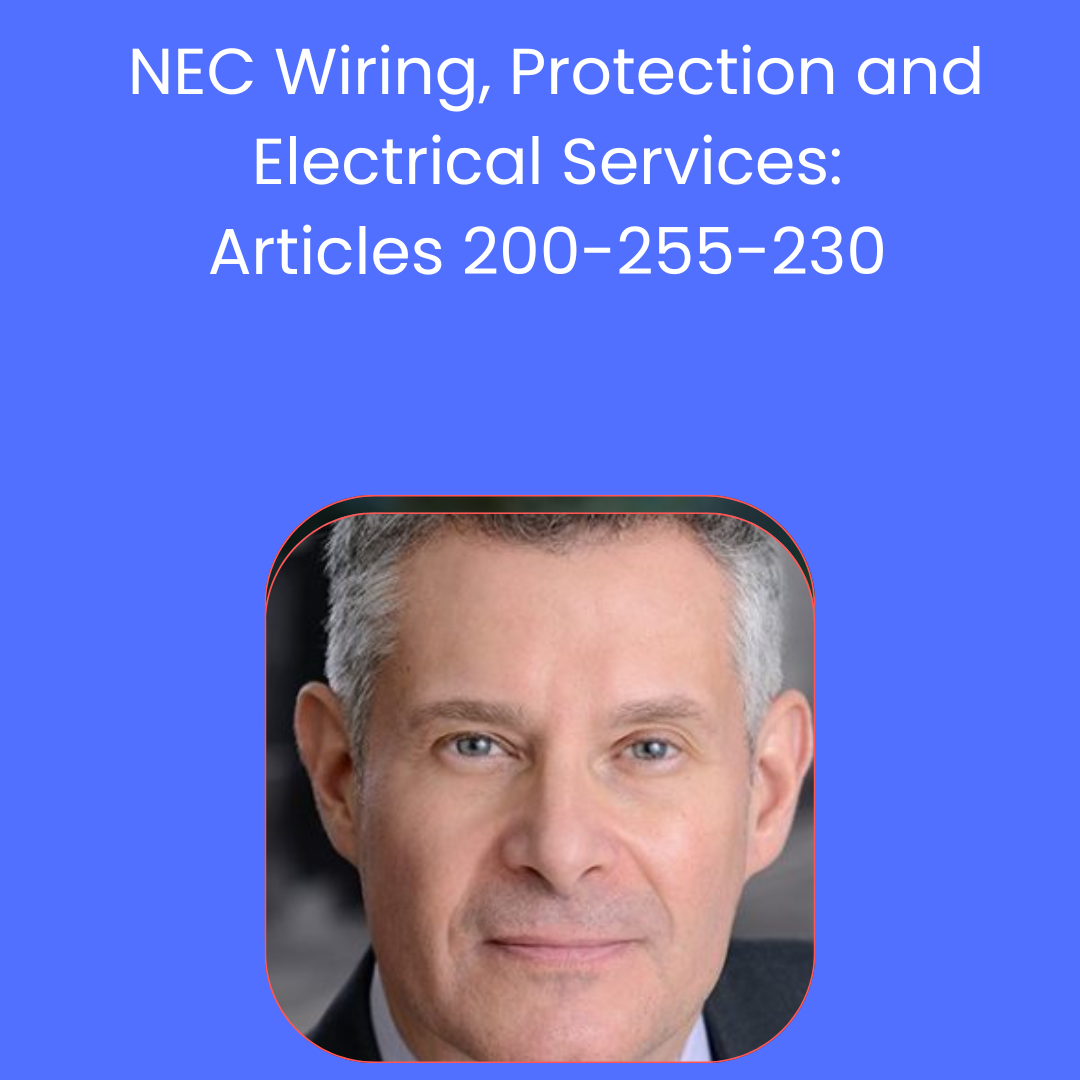
Shawn Gianella is a former multi tradesman who owned his service and contracting business for close to 3
Decades. He was one of the youngest Electrical Inspectors in the State at the time. He started teaching in the 80’s
and 90’s part time in public and private VoTechs. He emphasized the proper training of new workers and
apprentices as a consultant for a trade publication in the early 90’s. He instructs with old timer solid methods in
keeping one’s mind open and not just as someone writing on how to improve business that never spent a day in the
trades.d a live webinar: NJ Approved Instructor # 103
Webinar Information: If you are attending via Live Webinar: please read requirements below: this is NOT a taped class
You will need a smartphone, tablet, laptop or desktop computer to view it. If using a smartphone or tablet, it is best to have the app for the program on your device (i.e. Zoom).
To verify your continued attendance during the class, you will need a microphone and webcam as well as the ability to type into the program’s live chat.
Instructors or school personnel will take attendance periodically throughout the class.
Instructors may call on participants.
To verify attendance, a code word may be given sometime during the class.
You will be required to complete and return an evaluation after the course has ended. The evaluation may ask what code word was given.
You may not receive your Certificate of Completion if we cannot verify your attendance.
Webinar invitations are emailed to registered students approximately one day prior to the class.
Certificates of Completion are emailed to students approximately 5 business days after the course for those attending as
| Dates: | Live Webinar: Thurs. Sept. 24, 2026 Time: 3pm to 9pm EST, Attend at our School: Thurs. Sept. 24, 2026 Time: 3pm to 9pm EST, Live Webinar: Sun. Oct. 25, 2026 Time: 8:00am to 2:30pm EST, Attend at our School: Sun. Oct. 25, 2026 Time: 8am to 2:30pm EST, Live Webinar: Fri. Nov. 6, 2026 Time: 8:00am to 2:30pm EST, Attend at our School: Fri. Nov. 6, 2026 Time: 8am to 2:30pm EST |
|---|
Related products

Electrical

Electrical