
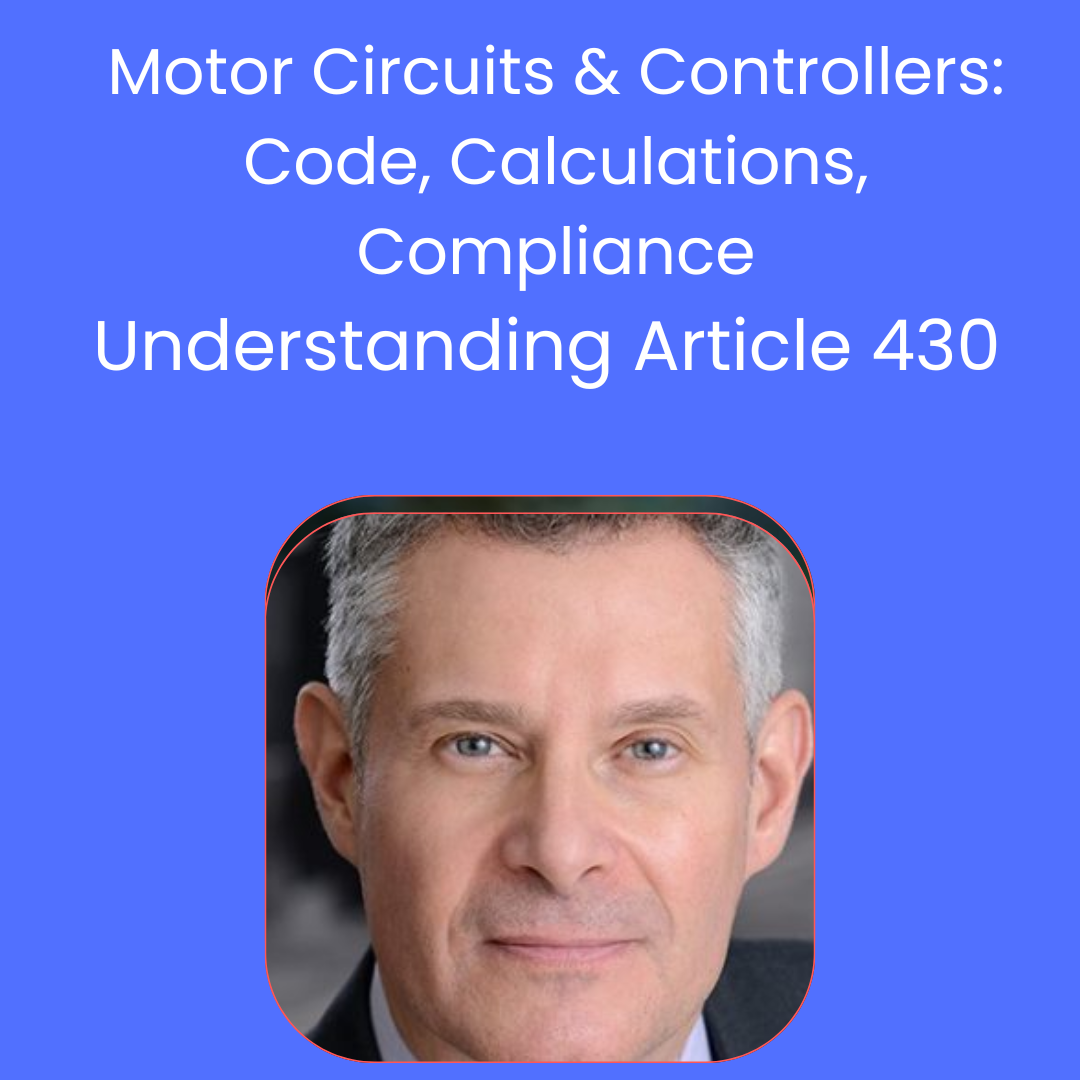
Motor Circuits & Controllers:Code, Calculations,Compliance –Understanding Article 430
Attend this program at our school or as a Live interactive Webinar from your location.
This 6-hour program covers the following topics:
Learning Objectives
By the end of this course, participants will be able to:
- Identify the scope and purpose of NEC Article 430 related to motors, circuits, and controllers.
- Interpret motor nameplate data and apply NEC tables for motor calculations.
- Calculate branch-circuit conductor sizing for single-phase and three-phase motors.
- Determine correct motor branch-circuit short-circuit and ground-fault protection.
- Explain the difference between overload protection and short-circuit protection.
- Properly size motor feeders supplying multiple motors.
- Identify the required disconnecting means for motor installations.
- Understand motor controller functions and installation requirements.
- Recognize common motor circuit installation violations and safety hazards.
- Apply Article 430 requirements to real-world installation scenarios
Course Description
Electric motors are one of the most common loads encountered in electrical installations across residential, commercial, and industrial environments. Proper design, installation, and protection of motor circuits are critical for safety, efficiency, and compliance with the NFPA 70: National Electrical Code.
This 6-hour continuing education course provides electricians with a detailed review of Article 430 – Motors, Motor Circuits, and Controllers. Participants will learn how to correctly size conductors, determine branch-circuit protection, apply overload protection, and understand controller requirements according to the NEC.
The course combines code interpretation, real-world examples, calculations, and troubleshooting scenarios to help electricians confidently apply Article 430 requirements in the field. Special emphasis will be placed on motor nameplate interpretation, feeder and branch-circuit sizing, short-circuit and ground-fault protection, disconnecting means, and common installation errors.
Upon completion, participants will have a stronger understanding of NEC motor rules and how to safely install and maintain motor-driven equipment.
Upon completion, electricians will have a stronger understanding of how to install and maintain lighting equipment safely while meeting NEC requirements.
Instructor:
Shawn Gianella is a former multi tradesman who owned his service and contracting business for close to 3
Decades. He was one of the youngest Electrical Inspectors in the State at the time. He started teaching in the 80’s
and 90’s part time in public and private VoTechs. He emphasized the proper training of new workers and
apprentices as a consultant for a trade publication in the early 90’s. He instructs with old timer solid methods in
keeping one’s mind open and not just as someone writing on how to improve business that never spent a day in the
trades.d a live webinar: NJ Approved Instructor # 103
Webinar Information: If you are attending via Live Webinar: please read requirements below: this is NOT a taped class
You will need a smartphone, tablet, laptop or desktop computer to view it. If using a smartphone or tablet, it is best to have the app for the program on your device (i.e. Zoom).
To verify your continued attendance during the class, you will need a microphone and webcam as well as the ability to type into the program’s live chat.
Instructors or school personnel will take attendance periodically throughout the class.
Instructors may call on participants.
To verify attendance, a code word may be given sometime during the class.
You will be required to complete and return an evaluation after the course has ended. The evaluation may ask what code word was given.
You may not receive your Certificate of Completion if we cannot verify your attendance.
Webinar invitations are emailed to registered students approximately one day prior to the class.
Certificates of Completion are emailed to students approximately 5 business days after the course for those attending as a Li
| Dates: | Live Webinar: Sat. Sept. 26, 2026 Time: 8am to 2:30pm EST, Attend at our School: Sat. Sept. 26, 2026 Time: 8am to 2:30pm EST, Live Webinar: Sat. Oct. 10, 2026 Time: 8am to 2:30pm EST, Attend at our School: Sat. Oct. 10, 2026 Time: 8am to 2:30pm EST |
|---|
Related products

Electrical
